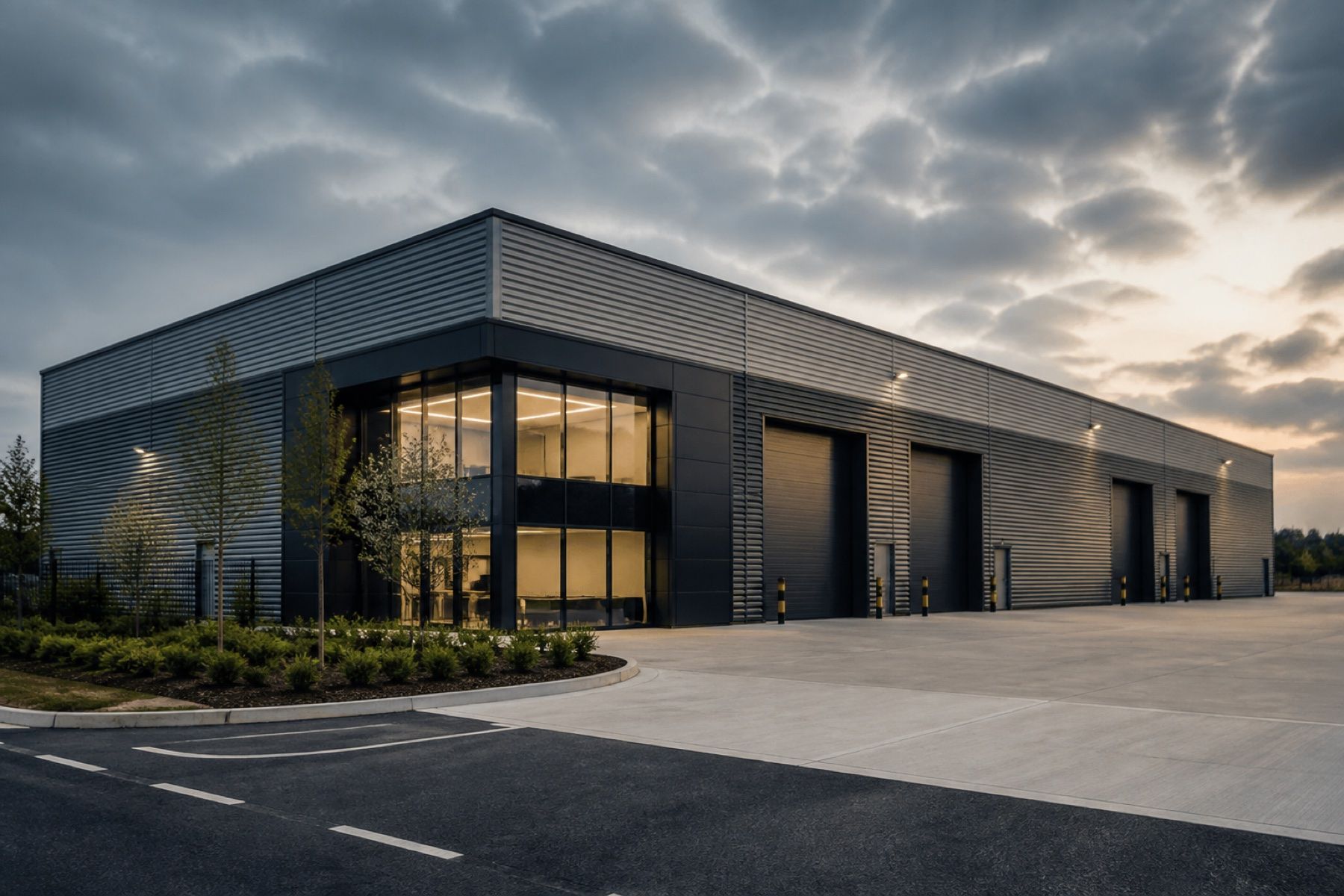
Industrial property bridging loan:units, warehouses and estates
An industrial property bridging loan is short-term finance secured on a factory, warehouse, trade counter or industrial estate that lets you buy, refinance or improve the asset quickly and repay later from a sale or a term facility. We arrange industrial bridging finance for investors, owner-occupiers and developers through a broad panel of bridging lenders, from specialist lenders to private credit funds.
Industrial and logistics space is a sector where lender appetite is usually strong, because demand for small and mid-sized units has been resilient and the buildings are simple to re-let. The questions lenders ask are different from offices or shops: they focus on ground conditions, past uses, roof materials and how specialist the building is.
Key takeaways
Standard industrial units and warehouses attract strong bridging appetite and LTV up to 70% to 75%.
Plant and machinery is excluded from the property valuation.
Environmental desktop reports and asbestos surveys are routine and should be commissioned early.
B2 and B8 sites sit outside Class MA, so residential conversion usually needs full planning permission.
A bridge only makes sense where speed, vacancy or a value-add plan rules out cheaper term finance.
)}
How do lenders view industrial and warehouse property?
Most bridging lenders see standard industrial units as one of the easier commercial assets to lend on. A well-specified shed with good yard space, eaves height and road access can be let to a wide range of occupiers, which gives the lender confidence in both value and exit.
Asset
Valuation basis
Lender appetite
Single-let warehouse or unit
Investment value on rent, lease and covenant
Strong where the building is standard and lettable
Multi-let industrial estate
Investment value across all tenancies, with voids reflected
Strong, income spread across many tenants reduces risk
Vacant unit
Vacant possession value
Good, as industrial voids are often short; LTV moderated
Trade counter
Investment value, location-led
Good, particularly on established trade parks
Specialist building (cold store, plant-heavy factory)
Value of the building only, with a view on alternative occupiers
Selective, lower LTV
Older site with redevelopment potential
Current use value; residential or alternative value supports exit only
Case by case, lower LTV
One important point: plant and machinery is not part of the property security. Racking, cranes, spray booths and production lines are excluded from the valuation, so do not expect to borrow against them on a property bridge.
What LTV is available on an industrial property bridging loan?
On a first charge, a standard industrial unit commonly supports LTV up to 70% to 75%, at the upper end of what bridging lenders offer on commercial property. LTV falls where the building is specialist, the site has environmental issues, the location is remote from main roads, or the loan is on a second charge.
Industrial lots also appear regularly at auction, where completion is usually due within 28 days. Model gross loan, fees and interest with the LTV calculator before you bid.
Environmental due diligence: why it matters on industrial sites
Industrial land often has a history. Fuel storage, metal finishing, vehicle repair, chemical storage and manufacturing can all leave contamination, and a lender holding a charge does not want to inherit a clean-up liability or an unsellable site. Expect the lender or its solicitor to ask for:
An environmental desktop report covering historic land use, nearby risks and flooding. Many lenders require one on every industrial deal.
A Phase 1 or Phase 2 assessment where the desktop report flags a risk, which can add time.
An asbestos survey, particularly for older units with fibre cement roof sheets or insulated panels.
Fire safety and insurance evidence, including the construction of composite panels.
Commissioning the desktop report as soon as you agree terms is one of the simplest ways to keep an industrial completion on track.
Have a deal in front of you?Send us the property and the numbers. We will tell you quickly whether it is fundable.
Leases, tenants and condition on industrial stock
For a let unit or estate, lenders read the tenancy schedule closely. They want to understand covenant strength, unexpired term, breaks and whether leases are full repairing and insuring. Multi-let estates with many small tenants on short leases can be valued well where occupancy has been consistently high, but lenders will want evidence of that track record.
Condition is the other half. Roof condition, eaves height, floor loading, loading doors, yard depth and power supply all affect how lettable a unit is. Energy performance also counts: the Minimum Energy Efficiency Standards apply to industrial lettings, so a poor EPC can delay a letting exit. Where the building needs work, a refurbishment bridging loan can include a works budget.
Planning and change of use on industrial property
Industrial uses fall into different classes. Light industrial use now sits within Class E in England, while general industrial (B2) and storage or distribution (B8) remain separate classes. That matters if your plan involves a change of use, for example converting a unit to a gym, a trade counter or residential. Class MA permitted development only applies to buildings in Class E use, so most B2 and B8 sites need full planning permission for residential conversion.
Bridging lenders will lend on current use value and treat planning upside as part of the exit story. If you are buying a site to obtain consent, read bridging loans for planning permission and confirm the planning position with a planning consultant.
Common industrial bridging deals and exits
Deal
Why a bridge fits
Typical exit
Owner-occupier buying its unit
Landlord or seller needs a fast completion
Owner-occupier commercial mortgage
Vacant unit bought to refurbish and let
Term lenders want a tenant first
Investment mortgage once let
Multi-let estate with voids
Time to lease up and improve income
Refinance on stabilised income or sale
Sale and leaseback purchase
Seller wants certainty on a short timetable
Investment mortgage on the new lease
Older site for redevelopment
Purchase ahead of planning and development finance
Development finance or sale with consent
Whichever exit you choose, an industrial property bridging loan works well when the exit evidence is ready at application. For lease-up strategies, see commercial bridge to let.
What are the downsides, and is there a cheaper alternative?
The main downside of any bridge is cost. Monthly interest and fees make it more expensive than a commercial mortgage, and if the exit slips you pay for every extra month, or face extension fees and default interest. A bridge only makes sense where speed, vacancy or a value-add plan rules out term finance.
If none of those apply, cheaper options include a commercial mortgage, a second charge loan or asking the seller for a delayed completion. Our guide to alternatives to bridging loans sets these out, and the bridge vs mortgage calculator compares the total cost.
How an industrial bridge is structured and regulated
Most industrial bridges are taken by a limited company or SPV with personal guarantees from directors. Interest can be retained, rolled up or serviced from rent, and an arrangement fee of typically around 1% to 2% of the loan applies. Lenders take a first charge over the property, and some also take a debenture over the borrowing company.
An industrial property bridging loan is unregulated where the property is held for business or investment purposes, and we arrange it directly. If the security included a home for you or an immediate family member, the loan could be a regulated mortgage contract, and we would introduce the case to a firm directly authorised by the Financial Conduct Authority.
Unregulated commercial and investment bridging is arranged directly. Any case where the security includes a home you or an immediate family member occupies, including a flat above commercial premises, may be regulated and is introduced to a firm directly authorised by the Financial Conduct Authority. We are not directly authorised by the Financial Conduct Authority ourselves. Your property may be repossessed if you do not keep up repayments on a mortgage or any other debt secured on it.
Good questions, clear answers
Industrial and warehouse bridging: questions answered
It depends on the monthly rate, the term and the fees, so we cannot give one figure. As an illustration, an arrangement fee of 1% to 2% on a £200,000 loan is £2,000 to £4,000, plus monthly interest for each month the loan runs, a valuation fee, legal costs and any exit fee. Our bridging cost calculator shows the total for your term.
What does Martin Lewis say about bridging loans?
We cannot speak for any commentator. We see bridging as relatively expensive short-term borrowing that should only be used with a clear plan to repay. In practice, an industrial bridge suits a defined purpose and a credible exit, not long-term funding.
Is there a cheaper alternative to a bridging loan?
Often, yes. If the unit is let and there is no time pressure, a commercial mortgage is usually cheaper. Other options include a second charge loan, a delayed completion agreed with the seller, or equity from a partner. A bridge earns its cost where speed, vacancy or a value-add plan rules term finance out.
What are the downsides of a bridging loan?
Bridging costs more per month than term finance, fees are paid upfront or added to the loan, and the whole balance is due at the end of the term. If your exit is delayed, extension fees or default interest can follow, and the lender can ultimately enforce its security. A realistic term and a well-evidenced exit reduce those risks.
Will a lender fund a contaminated industrial site?
Some will, but on a case-by-case basis and usually at a lower LTV. The lender will want environmental reports that quantify the issue, a remediation plan and a cost estimate, and comfort that the exit still works. Sites with known contamination often suit buyers planning redevelopment who already have specialist advice in place.